Taking flood protection to new heights for North Queensland producers

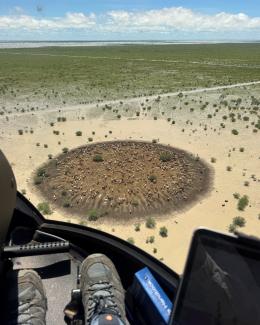
Aerial photo of massive paddock that's mostly flooded with murky water except for a circular mound that has lots of sheep on it. At the bottom of the photo are the pilot's feet and the frame of the helicopter window.

Photo credit: Scott Elliott, Blue Hills Helicopters.

On this page

Taking flood protection to new heights for North Queensland producers

Aerial photo of massive paddock that's mostly flooded with murky water except for a circular mound that has lots of sheep on it. At the bottom of the photo are the pilot's feet and the frame of the helicopter window.

Photo credit: Scott Elliott, Blue Hills Helicopters.

Written
  • Response
  • Resilience and risk reduction
  • Early recovery

When major flooding hits, primary producers can face the devastating losses of livestock, critical farm infrastructure and income. Following the 2019 and 2023 monsoon and flooding events that caused flooding and damage in North Queensland, we began looking at ways to both support recovery and prepare for future floods.

That is how the Australian Government’s North Queensland Recovery and Resilience Package (NQRRP) began. The program provides $91.8 million in funding to support northern Queensland communities.

Funded through the NQRRP, a CSIRO study has found flood refuge mounds (FRMs) can help livestock find safety during major floods, potentially saving thousands of cattle and protecting producers’ livelihoods.

FRMs are raised earthen structures that provide higher ground for livestock and critical farm infrastructure during floods.
Report findings

The On-Farm Resilience Study report, funded by NEMA, provides data and results from FRMs that were used during 3 major floods in the past 5 years.

The study found that circular FRMs are preferable to rectangular FRMs because they create slower-moving floodwaters. This reduces the risk of erosion. However, where rectangular mounds are the only option, the direction and placement of the mounds is important for effective results.

In addition, the report recommends that it is important to get vegetation cover growing on the mound as quickly as possible to maintain the structure’s integrity and prevent erosion.

The report also makes recommendations about the placement of multiple mounds and the space between each mound to ensure maximum effectiveness in saving livestock.

Next steps for primary producers

Reducing breeder deaths is critical to beef cattle herd recovery and long-term profitability. The study found that a 10% mortality rate and loss of breeders can add one to 3 years to the economic and productive recovery of the grazing business. Greater losses can increase recovery time to 5 years. If FRMs can reduce the mortality rate and minimise the loss of breeders, a producer’s recovery time can be dramatically reduced.

The study is now progressing to a trial phase, with the Queensland Department of Primary Industries working with local governments and graziers in North West Queensland to build FRMs for further trialling.

Queensland primary producers can access guidance from the Department of Primary Industries on design, construction and management of FRMs.

Find out more about further support for recovery from severe weather events through the NQRRP.