Responding beyond our shores

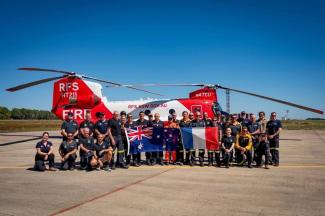
Large group of people posing in front of a large red and white RFS helicopter, holding large Australian and French flags, on a concrete runway area with blue sky.
On this page

Responding beyond our shores

Large group of people posing in front of a large red and white RFS helicopter, holding large Australian and French flags, on a concrete runway area with blue sky.
Written
  • Response
  • Support

When major disasters strike overseas, international cooperation can play a critical role in supporting communities and emergency services under pressure. France faced severe wildfires in August 2026 – its most challenging fire season in decades – and Australians deployed to work alongside French authorities to provide specialist aerial firefighting capability and operational support.

As part of that effort, NEMA deployed a liaison officer to France to help coordinate Australia's contribution and strengthen links between local and deployed teams. International partnerships in emergency management are increasingly important, sharing support and expertise as fire seasons become more extreme around the world.
Australia supports firefighting efforts in France

The fires, fuelled by extreme heat and dry conditions, forced the evacuation of hundreds of thousands of people across France and Spain. Thousands of firefighters were deployed as communities faced fast-moving and unpredictable fire behaviour that challenged traditional containment strategies.

Andy Price from NEMA's Crisis Planning Section was deployed to France as Australia's Liaison Officer, supporting emergency operations and helping coordinate Australia's contribution to the response.

For Andy, the scale of the situation became apparent as soon as he travelled south from Paris towards the deployment base in Mont de Marsan.

“Paris felt normal, but as we travelled through Bordeaux and further south it became evident how hot and dry it was, with drought-stressed and dying vegetation,” Andy said.

“We arrived in the middle of a heatwave and, on one of the early days of the deployment, I noticed the temperature on the dashboard of a car said 45 degrees.”

Australia's contribution included deploying our aerial firefighting capability to support French authorities. A CH-47D Chinook helicopter, equipped with an 11,300-litre water tank, and a Bell 412 reconnaissance and support aircraft were transported to France, accompanied by 24 highly skilled aerial and ground crew from the New South Wales Rural Fire Service. The Department of Foreign Affairs and Trade, Australian Defence Force and NEMA worked in close collaboration to make the mission happen and ensure its success. 

Two Royal Australian Air Force C-17 Globemaster aircraft and supporting personnel were deployed to transport the New South Wales Rural Fire Service aircraft and supplies. Once the New South Wales Rural Fire Service aircraft arrived, they first had to be reassembled after being stripped down for transport. When they were formally signed off for use, the aircraft were tasked to a large fire in a pine plantation only 25 kilometres away. The Australian contingent worked alongside French aircraft and more than 550 ground personnel to contain the fire.

Coordinating Australia's contribution

As Liaison Officer, Andy helped maintain communication between teams in France and Australia, supporting coordination and helping enable the safe and effective delivery of Australia's firefighting capability.

“With a complex deployment and multilayered integration into the French system, my days were often consumed with back-to-back meetings as the team worked through the enabling environment to allow operations,” he said.

While the French emergency management system felt familiar in many ways, Andy observed that agencies were confronting fire conditions unlike anything they had previously experienced.

“The French fire authorities operated in a well-structured system similar to what you would expect from any Australian jurisdiction,” he said.

“The notable challenge I observed was that the fire behaviour they were experiencing had exceeded the normal containment strategies they used.

“Just like in Australia, with years of custom and practice, training programs and experience, it can be hard to adapt to the changing climate and the effect this has on bushfire behaviour.”

The deployment was an opportunity for Australian and French emergency management teams to work closely together, sharing knowledge and adapting to increasingly complex fire environments in real time.

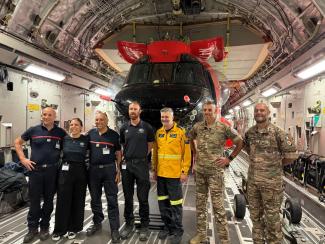
Seven people standing in a row, some in NEMA uniform, some in French Army uniform and 1 in yellow firefighter uniform. They are standing in front of a red helicopter, all inside a very large aircraft with cables and pipes visible across the curved ceiling.

Australian and French personnel on arrival in France.

Community resilience under pressure

One of the strongest impressions from the deployment was the way local communities supported the response effort.
“The community spirit was incredible,” Andy said.

“In Mont de Marsan, where we were based, people would stop to ask about the aircraft, or a meal would take twice as long because you ended up in a conversation about the capability with the staff.”

He also witnessed firsthand how communities rallied behind firefighters working on the front line.

“When I had the chance to visit the operational control point of a large fire just outside town, the local community was providing home-cooked meals 24 hours a day for 550 firefighters, and local farmers were arriving with agricultural equipment and large water tanks to refill firefighting units.”

The experience highlighted not only the importance of emergency services, but also the critical role communities play in supporting disaster response and recovery efforts on the ground.

Strengthening international partnerships

NEMA's support to France demonstrates Australia's ongoing commitment to international disaster cooperation and the exchange of emergency management expertise. As countries increasingly face the impacts of extreme weather, strong partnerships and the ability to work effectively across borders are becoming more important than ever.

As both a NEMA officer and volunteer Air Rescue Crew Officer with the New South Wales Rural Fire Service, Andy said he was proud to contribute to Australia's support for France during a difficult period.

“I was extremely proud to work alongside the team in my capacity as an Australian Government Liaison Officer to help deliver this capability in support of the French efforts.”

The deployment reinforced the value of sharing capability, knowledge and experience with international partners while also providing insights that help strengthen Australia's own preparedness and response arrangements. It showed how important it is for emergency management to be flexible and adaptable – everyone involved needs to stay agile and be prepared to pivot.

By working together during times of crisis, emergency management agencies can better support affected communities and build resilience for future challenges.

Read more about our international partnerships.