Bringing international lessons home

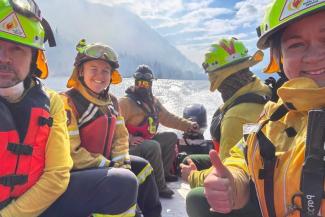
Five people in a dinghy on a lake, smiling, wearing yellow firefighting uniforms, helmets, and red life jackets. One person has their thumb up. The land in the far background has pine trees and smoke haze.
On this page

Bringing international lessons home

Five people in a dinghy on a lake, smiling, wearing yellow firefighting uniforms, helmets, and red life jackets. One person has their thumb up. The land in the far background has pine trees and smoke haze.
Written
  • Response

While Australia was settling into winter, NEMA’s Katie Tabke was thousands of kilometres from home, supporting wildfire operations in the United States.

Her deployment highlights the value of sharing experience across borders and shows how international cooperation can strengthen Australia’s disaster preparedness and recovery.

Katie works in NEMA’s Crisis Planning team and volunteers with the ACT Rural Fire Service in her spare time. She joined 21 personnel from the ACT Rural Fire Service, ACT State Emergency Service and ACT Parks and Conservation Service who deployed to North America in August.

During the 5-week deployment, she worked alongside firefighters from around the world in remote and rugged terrain. The deployment supported communities through a severe fire season and gave Katie valuable experience to bring back to her work at NEMA.
Supporting communities in challenging conditions

For Katie, the opportunity to deploy was one she could not pass up.

“In the ACT, I am part of a small team of firefighters who respond to particularly remote fire incidents as part of the Remote Area Firefighting Team,” Katie said.

“The deployment marked the first time arduous hand crews from Australia and New Zealand had been requested to support the USA, so I couldn’t put my hand up fast enough.”

In Idaho, Katie joined a specialist hand crew operating in areas often inaccessible to conventional firefighting vehicles. Reaching assigned locations sometimes required long hikes or boat transport. Once there, crews used hand tools to cut firebreaks down to bare mineral earth, clear dangerous fire-damaged trees and dig out affected areas.

The work involved long hours, physically demanding conditions and unfamiliar environments. It also demonstrated the importance of strong teams and coordinated support during an emergency.

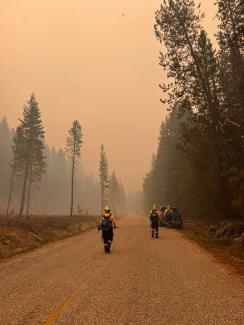
Photo of a fire trail with pine trees either side. The air is thick with smoke, making everything look orange. Two people walk away down the road towards a parked ute.

Preparedness strengthened through shared knowledge

Preparedness is built well before a disaster occurs. It relies on skilled people, strong partnerships and lessons learned from different approaches.

Working with international crews gave Katie firsthand insight into firefighting techniques and strategies developed in other parts of the world.

“Sharing this knowledge and bringing these tactics home to diversify and advance Australian fire management is extremely rewarding,” Katie said.

These exchanges strengthen the collective capability of emergency management personnel and help inform how Australia prepares for increasingly complex disasters.

Recovery starts with people and partnerships

Recovery is not only about rebuilding what has been damaged. It is also about helping communities reconnect, access support and build resilience for the future.

Katie’s deployment reinforced the value of trusted relationships across agencies, countries and local communities. The support shared between firefighters, medical teams, fellow Australians and local people helped crews continue their work under difficult conditions.

It also highlighted the personal connections that can endure beyond a deployment. For Katie, meeting other women on the fireground was a particularly meaningful part of the experience.

“When women connect in these intense environments, it so often leads to instant friendship. These immediate connections are full of so much respect, understanding and joy,” Katie said. 

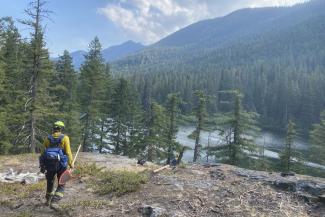
Photo of a person walking away carrying a shovel, across rocky ground, pine trees nearby and in the distance, a river below. Slight smoke haze is in the air but the sky is blue.

Bringing lessons back to NEMA

Despite occurring on the other side of the world, the fires reflected many of the challenges Australia faces, including extreme heat, dry fuel loads and longer fire seasons.

International deployments like Katie’s strengthen NEMA’s understanding of disaster risk and bring valuable operational insights to its work across preparedness, response and recovery. By sharing knowledge and building partnerships across borders, governments, emergency services and communities are better equipped to reduce disaster impacts and support recovery.

“This only emphasises the importance of our work at NEMA and the very real power we have to impact change and provide solutions in this space,” Katie said.

As Australia’s Higher Risk Weather Season continues, Katie returns to NEMA with practical experience and fresh perspectives that can help strengthen national preparedness and support communities before, during and after disasters.

Her deployment shows why NEMA’s role is so important: connecting people, knowledge and capability to help build a more prepared and resilient Australia.