Spring to bring heightened bushfire risk

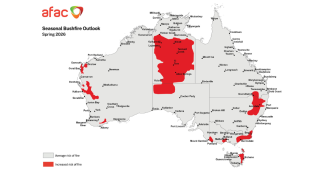
Map of Australia with red areas highlighted showing increased fire risk across most of NT, NW corner of SA, around Armidale and Goondiwindi in the east, around Bega and Bairnsdale in the southeast, the east coast of Tasmania, west of Melbourne and near Portland and Mt Gambier, and patches on the west coast.
On this page

Spring to bring heightened bushfire risk

Map of Australia with red areas highlighted showing increased fire risk across most of NT, NW corner of SA, around Armidale and Goondiwindi in the east, around Bega and Bairnsdale in the southeast, the east coast of Tasmania, west of Melbourne and near Portland and Mt Gambier, and patches on the west coast.
Written
  • Preparedness
  • Bushfire

Parts of the country are set to see an increased bushfire risk this spring.

Today, the Australasian Fire and Emergency Service Authorities Council (AFAC) released the Seasonal Bushfire Spring Outlook.

The outlook details a heightened risk of fire across:

  • northern and southeastern New South Wales
  • south-east Queensland
  • northeastern Tasmania
  • parts of Western Australia, South Australia and Victoria
  • large parts of the Northern Territory.

The heightened risk for the spring outlook period (September to November) is due to low soil moisture in New South Wales and Queensland, and increased fuel loads across Central Australia, the Barkley region and the Simpson Desert in the Northern Territory.

Below average rainfall has increased the risk in northeast and eastern Tasmania and part of Victoria. For parts of Western Australia, the elevated fire risk is due to above average fuel loads and dry soil conditions.

The Seasonal Bushfire Outlook combines expert analysis of bushfire fuels, past rainfall, temperature, and climate outlooks prepared by the Bureau of Meteorology.

Preparing for heightened risk

We are prepared and ready to support states and territories as we head into spring and the next Higher Risk Weather Season (HRWS).

We’re working to support disaster preparedness, prevention and recovery through:

National Resilience Action Library

The National Resilience Action Library brings together a collection of strategies and resources for homeowners to reduce the impacts of natural hazards.

The Natural Hazards Awareness Modules complement the library and contain practical guidance for homeowners, buyers, renters and business owners to increase their resilience.

For more information on how to prepare, see the NEMA website.