One year on: from recovery to resilience after Tropical Cyclone Alfred

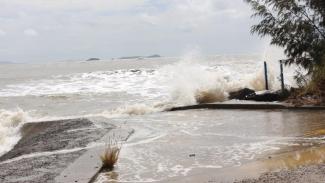
Photo of very rough ocean, grey/brown, hitting a coastal wall.
On this page

One year on: from recovery to resilience after Tropical Cyclone Alfred

Photo of very rough ocean, grey/brown, hitting a coastal wall.
Written
  • Case study
  • QLD
  • NSW
  • Resilience and risk reduction
  • Response
  • Reconstruction
  • Early recovery
  • Relief
  • Preparedness

In late February 2025, a tropical low developed over the Coral Sea off the east coast of Australia. It soon gathered strength to become Tropical Cyclone (TC) Alfred and brought extremely strong winds, heavy rain and flooding across southeast Queensland and northeast New South Wales.

TC Alfred was the first tropical cyclone to impact the Brisbane region in more than 50 years. It made landfall as a category 1 but peaked as a category 4 off the coast and ranked among 2025’s costliest global disasters.

As our Queensland Coordination and Planning Officers (CPOs) reflected, it’s hard to believe TC Alfred was a year ago. This team has just finished responding to TC Narelle in Queensland, which followed several other significant weather events this season. They say it’s amazing to see, yet again, how resilient communities are across the state.
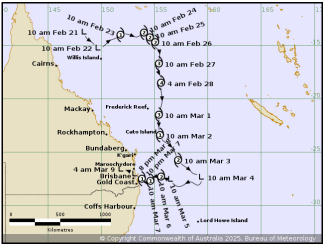
Map of Queensland coast and Coral Sea showing the track of TC Alfred from north to south then west directly towards Brisbane and the Gold Coast.

The path of TC Alfred over the Coral Sea from north to south and then west towards Brisbane. Image: Bureau of Meteorology

The calm before the storm

In preparation for TC Alfred’s impact, we activated the National Emergency Management Stockpile without delay.

We sent our full stock of 125,500 sandbags from the Effective Logistics Warehouse in Melbourne to Brisbane. Within 5 hours of arrival, teams distributed all the sandbags to different Local Government Areas in southeast Queensland. This rapid response made sure local authorities had the resources they needed and helped residents reduce the impact of flooding on their homes and businesses.

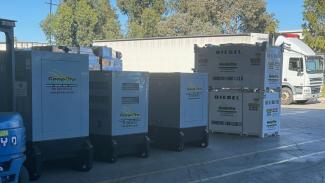
We also mobilised 6 large generators to Tweed Heads South, New South Wales, to assist with power outages caused by the weather conditions.

Photo of 3 large grey generators and 2 large tanks labelled diesel fuel.

Three of the generators sent to New South Wales from the National Emergency Management Stockpile.

Our CPOs were ready, deployed as Liaison Officers to the State Disaster Coordination Centre. Training exercises throughout the year helped communities and our CPOs prepare for times like this, and the CPO team say it’s incredible how much of a difference that makes to community preparedness. TC Alfred was yet another opportunity to exercise well-versed plans. Local governments kept communities updated via their local disaster dashboards, Districts pulled together regional resources, and emergency response agencies worked together to provide effective, multi-agency response and recovery efforts.

Changing gears: from response to recovery

In the weeks and months that followed TC Alfred, the focus turned to restoring normality for affected individuals and reestablishing transportation routes throughout the region. The Australian Government, in partnership with the Queensland Government, deployed significant support under Categories C and D of the Disaster Recovery Funding Arrangement (DRFA)—the most severe categories of assistance. This funding totalled $265.15 million.

As of January 2026, over $6.95 million had been paid in recovery grants for primary producers, over $2.03 million for small businesses and not-for-profits, and over $10,000 for rural landholders. These grants fall under Categories A and B of the DRFA.

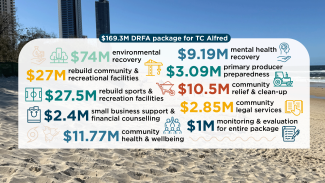
The $169.297 million recovery program following TC Alfred supported a wide range of initiatives, including environmental restoration, rebuilding community and sports facilities, and supporting small businesses. It also provided funding for community health and wellbeing especially for vulnerable groups, mental health services, primary producers’ resilience, legal and case management support, and ongoing monitoring and evaluation to ensure recovery goals were achieved.

Infographics showing the categories of support funded by the $169.297M package, overlaid on a photo of the beach at the Gold Coast, with skyscrapers on the left.

In addition to the DRFA, the Australian Government Disaster Recovery Payment (AGDRP) and Disaster Recovery Allowance (DRA) were both activated for TC Alfred. This assistance was a lifeline to those whose lives were upended by the catastrophe. For families facing the heartbreak of losing their homes, cherished possessions or local businesses, this financial support also offered hope and reassurance during the darkest days. These payments meant people could begin to rebuild, knowing they were not alone and that their community stood behind them.

The DRA is a short-term income support payment to help individuals who have lost income as a direct result of the disaster. It is up to 13 weeks of pay and was available in 17 Local Government Areas. The AGDRP is a one-off payment that was provided to people who were significantly affected by TC Alfred in specific areas within 12 LGAs.

The recovery for TC Alfred has been a long journey, but as the Queensland CPO team says, it’s been impressive to witness resilience measures being integrated every step of the way. Local governments have adopted lessons learnt into plans and processes, communities have prepared for Higher Risk Weather Season earlier, business owners have revised their Business Continuity Plans and emergency responders have exercised even more extreme scenarios. In a disaster-prone state like Queensland, the long-term impacts of significant weather events on communities are hard to measure but likely to continue. However, if Queensland’s response to TC Alfred or any other event from the past year have taught us anything, it’s that crisis is an opportunity for positive change. 

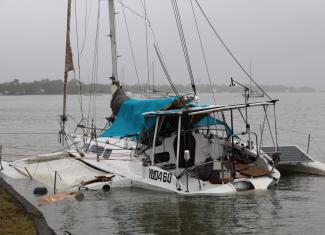
A catamaran/yacht damaged and half submerged in the water, grey skies and rainy weather.

Beyond recovery: investing in resilience

As part of overcoming TC Alfred and settling into a new normal, it is critical we learn from this disaster to help us prepare for the future. Our investment strategy over the last year has focused on resilience and ensuring that when the next event occurs, the impact is significantly reduced. 

The Disaster Ready Fund

Disaster risk reduction funding is strengthening Australia’s national resilience to disasters. There are several projects being delivered through the Disaster Ready Fund that will better prepare the region impacted by TC Alfred for future events.  

  • Crockatt Park seawall renewal, Moreton Bay, Queensland: a new seawall to provide erosion protection, protect infrastructure behind the seawall and improve safety along the foreshore. 

  • Coastal protection works – Karragarra Esplanade seawall, Karragarra Island, Queensland: a seawall along the foreshore to protect the road and electrical infrastructure. 

  • Currumbin training wall upgrade, Currumbin, Queensland: upgrading the 200m long coastal protection structure, to ensure it continues to provide effective protection against coastal hazards for the next 50 years.  

  • Captain Cook Parade seawall rebuild, Deception Bay, Queensland: replacing a failed section of the seawall. 

  • Queensland flood forecast and warning system: a new system to provide road authorities with advanced notice of when and how roads and bridges will be impacted by flooding events, as well as help calculate when areas can be reopened after flooding.  

  • Nature-based ecological restoration, New South Wales North Coast rivers and coast: rehabilitating natural ecosystems across 43km and 128ha of streambank and coastline, reducing disaster risk and increasing resilience to floods, storms and cyclones.

The Hazards Insurance Partnership

The rising risk of natural hazards in Australia is contributing to an increase in insurance costs, making it unaffordable for some people. For those with insufficient insurance coverage, post-disaster recovery becomes even more complicated.

The Hazards Insurance Partnership brings the Government and the insurance industry together to discuss how to lower risk and better ways to collect and share information. The aim is to find where insurance is a problem in high-risk areas and develop policy solutions to reduce risk and cost. In the long-term, this will help individuals’ and communities increase their resilience and recover from disasters.

While we celebrate the milestones reached one year on, NEMA recognises that for some, the journey is far from over. Recovery is a gruelling process and sometimes delayed by consecutive disasters. We remain on the ground, working with local councils and state governments to ensure no community is left behind.