Updated National Principles for Disaster Recovery have been released

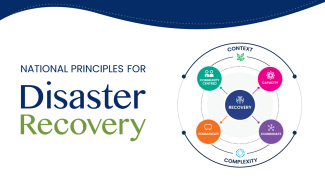
'National Principles for Disaster Recovery' next to a schematic with interconnecting circles.
On this page

Updated National Principles for Disaster Recovery have been released

'National Principles for Disaster Recovery' next to a schematic with interconnecting circles.
Written
  • Resilience and risk reduction

Government departments and recovery agencies, non-government stakeholders, disaster-affected communities and the Australian Institute for Disaster Resilience have worked together to update the National Principles for Disaster Recovery.

The principles are a resource developed by the Social Recovery Reference Group, an independent group of representatives from human and social relief and recovery government organisations, of which NEMA is a member. These principles can be used by communities, governments and recovery agencies to guide our efforts, approach, planning and decision-making in disaster recovery.
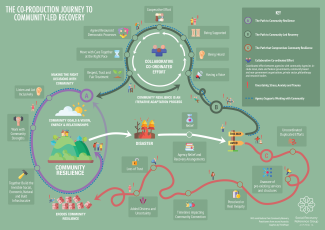
Community centred recovery

Disasters can have lasting impacts on people, communities and livelihoods. Recovery is complex, long-term, non-linear and dynamic. This is particularly true when multiple disasters happen back-to-back or at the same time.  

Every community is unique and will face distinct challenges in the emergency management context. The principles aim to help communities best recover from the sense of loss and uncertainty experienced during disasters.

The principles

Understand the context

Successful recovery is based on an understanding of the community context, with each community having its own history, values and dynamics.

Recognise complexity

Successful recovery is responsive to the complex and evolving nature of disasters and their impacts on communities, including compounding, cascading and concurrent events.  

Use community-centred approaches

Successful recovery is community-centred, responsive and flexible, engaging with community and supporting them to move forward, with shared responsibilities.

Coordinate all activities

Successful recovery requires a planned, coordinated and adaptive approach, between community and partner agencies, based on continuing assessment of impacts and needs.

Communicate effectively

Successful recovery is built on effective communication between the affected community and other partners.

Recognise and build capacity

Successful recovery recognises, supports, and builds on individual, community and organisational capacity and resilience. 

Find out more about the principles at National Principles for Disaster Recovery.