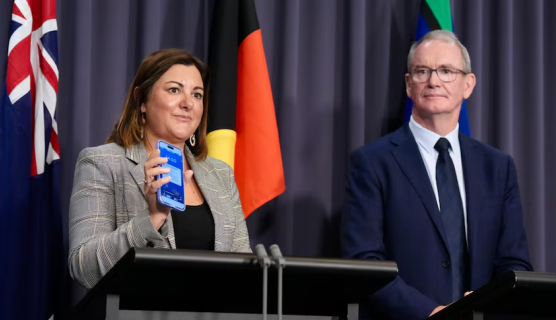
Paul Culliver: Something kind of interesting is going to happen on Monday afternoon. Everyone's phone's going to go off at the same time. Let's find out why. Katarina Carroll is the Deputy Coordinator General with the Emergency Management and Response Group and joins you on the line. Katarina Carroll , good morning to you.
Katarina Carroll: Good morning to you, Paul.
Paul Culliver: What's happening on Monday?
Katarina Carroll: Monday is pretty exciting time for emergency management. Everyone will be receiving at 2PM a critical alert. It's called AusAlert. A message will come, a national test, a message will come to your phone notifying you that it is a critical test and it is a test. Now what this is, is this is a new capability for emergency management. At the back end of the Black Summer bushfires, the Royal Commission found that we needed a national messaging service. The current one has its limitations. It is reliant on accessing your telco provider and it's a text message and it's limited by network congestion and coming from my background in emergency management in Queensland in fire and policing, I definitely know it has its limitations. So, this new technology is cell broadcast technology, so, it's telco agnostic, so, it will send you a message to your phone, irrespective of whether it's Telstra or Optus, it'll pick up the nearest tower and immediately send that message to your phone.
Paul Culliver: Okay, so if you're out in a public space at 2 o'clock on Friday, is that just going to be everyone's phones going off at once? Is that the likely experience?
Katarina Carroll: Yes, 2 o’clock Monday. 2 o‘clock Monday.
Paul Culliver: Oh yeah, sorry, what did I say? Yeah, yeah, two o' clock Monday.
Katarina Carroll: Yeah, two o' clock Monday the 27th at 2:00pm Australian Eastern Standard Time. Yes. So, we expect, you know, Apple advises us that 80% of their devices can receive AusAlert. There's about 15.7 million Android devices that will be receiving it. So, we expect most people will be getting the message at 2 o'clock. It'll be a siren for a start. So, your mobile will vibrate and make a loud siren noise and It'll last for 10 seconds. So, because it is a critical alert, you cannot override it so it will actually vibrate through silent or do not disturb as well.
Paul Culliver: Okay, talk to me about those non compatible devices. So, what's going on there with devices that won't be able to receive this alert?
Katarina Carroll: So, this is just your older devices. So, if you have a device prior to 2019, some older devices might not be able to receive the alert, however, it is incredibly important that you have your software updated. Good practice for cyber issues but also if you update your devices, you will more than likely get the AusAlert. So, it's incredibly important to update your devices and certainly we know over time as older phones go out of the market, there will be more people that will be compatible.
Paul Culliver: Okay, why institute in a system like this where we've got this overriding this alarm siren sound as opposed to say just everyone receiving a text message that's in the area that needs to get the alert?
Katarina Carroll: Yeah, that's incredibly important question, Paul. So, there's two types of alerts. There's priority, that we'll use where people need to be aware of things, but critical is imminent threat to life and property. So, we see it being used in fires, in floods, where you need to get that instantaneous message out and your life or your property is being threatened. So, an incredibly important tool in the suite of tools, you know, we currently have a lot of tools in terms of emergencies. We have radio, we have, you know, websites, we have our current system, the Emergency Alert, but this is another tool again.
Paul Culliver: Okay. And so just to be clear about the different scenarios, natural disasters and where life and property are in risk, makes a lot of sense for critical alerts. Are there other situations, I mean, God forbid, you know, like an active shooter or something like that, some kind of public danger event. Is that the kind of a scenario we might also see this used in?
Katarina Carroll: Yes, definitely. So, it can be geocoded with 160 metres of an event, so it can be quite accurate. And in countries that have used this, and there are over 35 already, they found that once they implement it, that they used it more often for very different scenarios to what we use now because it is instantaneous and it is quite accurate.
Paul Culliver: Okay. And so to implement this, I'm just curious about what the work has been to make this even possible, that we can all just get this alert at the same time on our phones across the country.
Katarina Carroll: This has been an incredible piece of work over two years with telco, with device manufacturers. So, the relationship behind the scenes has been extraordinary because we all find this as, you know, just a wonderful step in terms of making our community even safer. So, there has been a lot of work over two years. It has been tested in nine communities across Australia already in the priority alert. But it was incredibly important that we test it at that critical alert stage because it really looks at real world, you know, at volume, at speed and across the entire nation to make sure that it is successful.
Paul Culliver: Katarina Carroll is with you this morning. Deputy Coordinator General with the Emergency Management and Response Group with the National Emergency Management Agency. It’s 12:33 on ABC Newcastle. We're talking about this AusAlert Critical Alert Test that will happen on Monday afternoon. Katarina Carroll, I'm sure you're aware many DV groups have come out and been somewhat concerned because it might be quite common for people that are living in at risk situations, DV situations, where they might have what is effectively a secret phone that is used for emergency situations or to contact loved ones where they might have a controlling spouse and the like. People can imagine that scenario, unfortunately. What is being done there, because the concern is that this may expose these secret phones and indeed put people in danger if their phone goes off during this test.
Katarina Carroll: Yeah, thanks, Paul. Hidden phones, as we know, are incredibly important to keeping, you know, people safe. So, we've worked now for a couple of years with WESNET, that's a national body for domestic and family violence as well as National Alliance of Domestic and Family Violence Specialist. So, we, with them, have come up with a guide to staying safe during the AusAlert national test. So, the advice is, if you like to say there's two pieces here. So, if you actually have a very important meeting or you can't, you know, you're in a situation where you just can't have that alert come to your phone next week, you should turn it off an hour before, an hour after. But the advice for domestic and family violence victims is to switch it off for 24 hours. Now, the other piece that we are working through our peak bodies is, through our trusted partners is, that we use these channels to actually talk to the victims in a trusted environment and with discretion and to ensure consistency rather than using broad communications to the general public. So, this is incredibly important to note this. There is a lot of work behind the scenes that wouldn't be visible, which is incredibly important, as well as public messaging as well. So, 24 hours, particularly for those victims of domestic and family violence.
Paul Culliver: Okay, so just to be clear about that's about turning the actual phone off. Is that the only way to stop getting those alerts?
Katarina Carroll: Yes. Either turning the phone off or putting it in aeroplane mode.
Paul Culliver: Okay, so anyone that's just in aeroplane mode or has their phone off won't receive these alerts during that time?
Katarina Carroll: That's correct.
Paul Culliver: Okay, I suppose this then goes to, this is a test where you can give lots of notice to people that this is going to be happening. There is still the chance down the track where there's a critical alert being sent out and it will still expose those hidden phones, right?
Katarina Carroll: We think a small chance because there are many other avenues that you'll be getting messages, say, you know, I come from Far North Queensland. I was just listening to that ride that's coming, that event starting in the Cape. But that part of the world, you already are exposed to many other tools in emergency management that, you know, something might be happening normally. You know, you have the radio, you have the website, there's many other means, and the critical alert is just one of those.
Paul Culliver: Okay, so just to be clear about. So, you're saying that if there is someone who has a hidden phone because they're in a DV situation, if they're aware that something's already happening in their community, they should then be going to turn their phone off in advance. Is that the advice?
Katarina Carroll: Yeah, that would be the advice. But it would be rare that, you know, people would have a critical alert without being aware that something's happening. So, yes. So, for good practise. For good practice, you should turn off your device if you know that there is something happening.
Paul Culliver: Okay. Anything else that you want the public to know ahead of this test on Monday?
Katarina Carroll: You don't have to do anything, so just wait till the test arrives. But certainly we would like to hear from the public. So, there is feedback available on ausalert.gov.au we will have device manufacturers, the telcos, looking at how technically this responds and works. So, we know that it has worked and it's our first critical test and we're hoping the same will happen and we're sure it will, but we would love to hear from the public, so go to our website, ausalert.gov.au there will be a survey in there and give us your feedback.
Paul Culliver: Katarina Carroll, appreciate your time today. Thank you.
Katarina Carroll: Thank you, Paul.