Women at the heart of emergency management

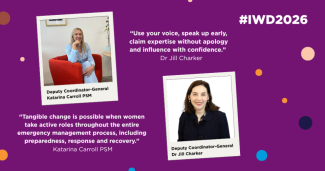
Photo of Katarina with quote "Tangible change is possible when women take active roles throughout the entire emergency management process, including preparedness, response and recovery" and Jill with quote "Use your voice, speak up early, claim expertise without apology and influence with confidence"
On this page

Women at the heart of emergency management

Photo of Katarina with quote "Tangible change is possible when women take active roles throughout the entire emergency management process, including preparedness, response and recovery" and Jill with quote "Use your voice, speak up early, claim expertise without apology and influence with confidence"
Written
  • Case study
  • Response
  • Resilience and risk reduction

This International Women’s Day, we reflect on the theme ‘Balance the Scales’ by recognising the critical role women play across the emergency management continuum. From national leadership to community recovery, women are shaping more inclusive, resilient outcomes for the communities we serve.

Two of our Deputy Coordinator-Generals (DCG) at NEMA, Dr Jill Charker and Katarina Carroll, share their perspectives on leadership, equity and the importance of women’s voices in emergency management. Their insights emphasise a common understanding: when women are visible, supported, and empowered to make decisions, outcomes improve for all stakeholders.
Motivation grounded in service and impact

For Dr Jill Charker, DCG Disaster Resilience and Recovery Group, NEMA’s connection to helping people on the ground after they have often been through “the worst day of their lives”, is a powerful motivator. “It’s not hard to stay motivated when we see the increased frequency and severity of disaster events, and we can see the importance to get in front of disasters through smart investment in risk reduction.” Central to this motivation, Dr Charker says working alongside such a committed and capable team is something she values deeply.

Similarly, Katarina Carroll, DCG of Emergency Management and Response Group, brings a lifetime of operational experience across policing, fire and emergency services, and disaster recovery. Having worked at local, state and national levels, she is energised by the pace and impact of emergency response and the strength of NEMA’s partnerships with states and territories. For her, emergency management is not just a profession, it is a way to make a tangible difference to communities under pressure.

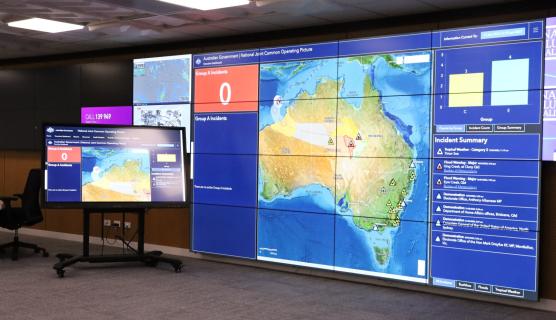
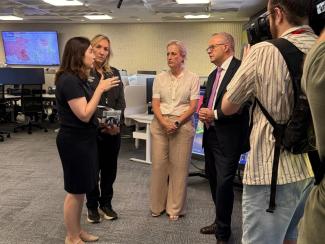
In the National Situation Room with cameraman in the foreground filming Jill and Katarina talking to Senator Katy Gallagher and Prime Minister Anthony Albanese. All look serious.

Deputy Coordinators-General Dr Jill Charker and Katarina Carroll (left) briefing Senator Katy Gallagher and Prime Minister Anthony Albanese (right) in the National Situation Room.

Where equity gaps persist

Both Jill and Katarina point to the way disasters amplify existing inequalities. Women often act as the “connectors” within communities, providing informal leadership, care and coordination, yet this work is frequently invisible and undervalued. Caring responsibilities, unpaid work and disrupted support systems can place additional strain on women during recovery.

Beyond gender, equity gaps are felt most sharply by people who are uninsured, those for whom English is not a first language, First Nations communities in remote areas, older Australians, and people living with disability. “Disasters also exacerbate gender-based violence, which is made worse from disruptions to support systems, financial and emotional stress and heightened environmental factors.” said Katarina.

Addressing these gaps, both leaders agree, requires education, early investment in disaster risk reduction, and inclusive approaches that reflect the diversity of the communities affected.

Lessons in leadership and using your voice

Asked about the lessons they have learned as women in the workplace, both leaders emphasise confidence, courage and growth.

Dr Charker cautions against the trap of always trying to be “likeable”, encouraging women to act respectfully while backing their judgement and continuing to learn. She stresses the importance of using your voice, speaking up early, claiming expertise without apology and influencing with confidence.

Katarina Carroll encourages women to take and create opportunities, even when they feel uncomfortable or unprepared. Her career has been shaped by saying yes to challenges, moving roles frequently and building trusted networks that both support and challenge her. Continuous learning, whether formal education, experiential development or broad reading, has been central to her leadership journey. “You must be challenged in order to grow,” said Katarina.

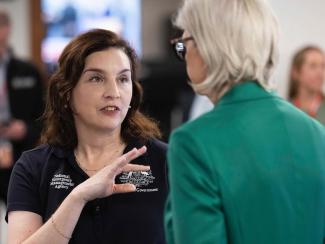
Close up shot of Jill explaining something, viewed over the shoulder of the Governor General.

Dr Jill Charker talking with the Governor General Sam Mostyn.

Building inclusive pathways and visible leadership

Looking ahead, both leaders are hopeful about progress toward gender equality across NEMA and the APS, while acknowledging there is more to do. Flexible career pathways, diverse leadership styles and inclusive workplace cultures are critical to sustaining momentum. Leadership, they argue, does not need to conform to outdated models of visibility, hierarchy or command‑and‑control behaviour.

Ensuring women are visible in decision‑making means examining systems and structures across the entire emergency management cycle. It requires asking where women are represented, where they are missing, and whether they hold real decision‑making power, particularly over resources and strategy. Long‑term investment in mentorship, sponsorship and leadership development, from both women and men, is essential to building a strong pipeline of future leaders.

Inspired by women who lead with humanity

Both leaders credit inspiring women who model leadership grounded in competence, compassion and authenticity. Dr Charker speaks with admiration for Her Excellency the Hon. Sam Mostyn AC, noting her focus, community insight and consistent recognition of staff. Katarina Carroll reflects on the influence of Deputy Commissioner Kathy Rynders, whose credibility, warmth and people‑centred leadership left a lasting impression early in her career.

This International Women’s Day, their stories remind us that balancing the scales is not a single action, but a sustained commitment to inclusive leadership, visible decision‑making and systems that recognise the full contribution of women. When it comes to disaster resilience and recovery, ensuring equity isn't just an obligation, it's also key to achieving improved results for the communities we support.