The 2025–26 Higher-Risk Weather Season lives up to its name

stats for 2025-26 HRWS
On this page

The 2025–26 Higher-Risk Weather Season lives up to its name

stats for 2025-26 HRWS
Written
  • Case study
  • Response
  • Resilience and risk reduction

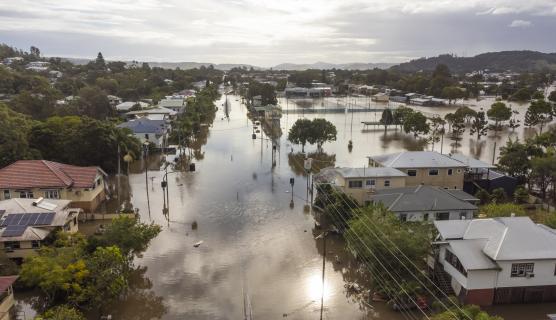
As the 2025–26 Higher-Risk Weather Season (HRWS) comes to an end, we are reflecting on months marked by intense storms, flooding, bushfires and extreme heat. These events tested communities’ resilience across the country.  

Homes, infrastructure and livelihoods were impacted, showing the effects of natural hazards and highlighting the importance of strong coordination across all levels of government and the community.  
Preparedness briefings

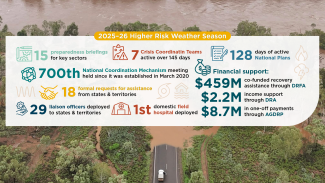
In the lead up to the HRWS, we delivered 15 preparedness briefings to key sectors, including emergency services, health, infrastructure and local government agencies. These briefings helped ensure stakeholders understood seasonal risks and response strategies ahead of expected high-risk periods.  

National plan activations

National plans were activated for a total of 128 days with two activations of COMDISPLAN to provide support to Australian communities including bushfires in South Australia and Victoria, flooding and tropical cyclone impacts in Northern Territory and Western Australia. AUSASSISTPLAN was also activated once to support a severe Dengue Fever outbreak in Samoa. Each national plan activation enabled rapid deployment of Australian Government resources and coordination with state and territory counterparts.

National Coordination Mechanism activities and milestones

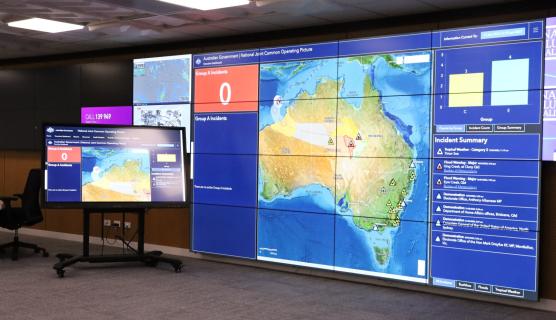
The National Coordination Mechanism (NCM) led strategic national coordination supported by the 24/7 operations of the National Situation Room (NSR). The NCM supported 7 Crisis Coordination Teams throughout the season, including in response to ex-Tropical Cyclone Fina and ex-Tropical Cyclone Narelle and the related supply chain disruptions.  

A significant milestone was reached on 16 April 2026 with the 700th NCM held since the mechanism was established in March 2020.  

Crisis Coordination Team activations

The Crisis Coordination Team (CCT) was activated for a total of 145 days during the season, to support large-scale flood and bushfire responses as well as deploying to support planning and response activities. The CCT supported the very first domestic deployment of a field hospital in Katherine and a multidisciplinary team that provided planning support across response and recovery activities in the NT. These activations helped keep Australian communities safe and ensure seamless integration of Australian Government support with local incident management teams.  

Requests for support from states and territories

States and territories made 18 formal requests for Australian Government assistance. This included food and accommodation for firefighters in Victoria and South Australia through the National Emergency Management Stockpile and Australian Defence Force. The national aerial firefighting capability was utilised to support local firefighting crews around the country including the national aerial fleet to help contain and suppress fires. Evacuation support was also provided to help get people out of harm’s way during significant flooding. In Katherine, assistance included evacuating residents, cleaning up flood damage and providing an Australian Medical Assistance Team (AUSMAT) field hospital following Ex-Severe Tropical Cyclone Narelle.  

Financial support  

As at 4 May 2026, we have committed to cost share over $459 million in extraordinary recovery assistance in New South Wales, Northern Territory, Queensland, Tasmania and Victoria through Disaster Recovery Funding Arrangements. To assist Australians who have lost income as a direct result of major disasters this season, over $2.2 million has been delivered through the Disaster Recovery Allowance (DRA). For those Australians significantly affected by a major disaster, $8.7million has been delivered through the Australian Government Disaster Recovery Payment (AGDRP).

Coordination and Planning Officers

We deployed Coordination and Planning Officers 29 times as Liaison Officers to state and territory emergency operations centres. They supported responses to nationally significant events including ex-Tropical Cyclone Narelle, Northern Territory and Queensland flooding and the Victorian bushfires. 

Learning for future seasons

The 2025–26 HRWS highlighted the importance of strong preparedness, effective coordination across governments and flexible response capabilities. Timely activation of national plans, targeted use of resources, and close support to states and territories helped reduce impacts and protect communities across Australia.

During this ‘off’ season, our National Crisis Exercising and Lessons team will undertake an after-action review and lessons process, strengthening preparedness activities and staying engaged in planning and briefing efforts to ensure Australia is ready for the next HRWS.