2025 in review: a year of collaboration, coordination and capability building

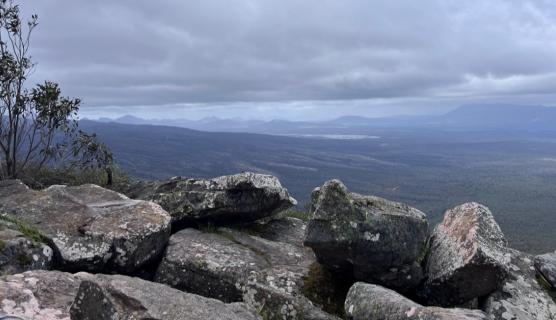
Photo from atop a mountain overlooking bushland with grey granite rocky ground to the right and blue skies with scattered clouds. Overlaid is text that says 'NEMA 2025 year in review'.
On this page

2025 in review: a year of collaboration, coordination and capability building

Photo from atop a mountain overlooking bushland with grey granite rocky ground to the right and blue skies with scattered clouds. Overlaid is text that says 'NEMA 2025 year in review'.
Written
  • News

Australia’s national emergency management and risk reduction efforts in 2025 have been robust, coordinated and far-reaching. To highlight the scale and impact of these efforts, let’s explore some of the numbers behind the National Emergency Management Agency’s (NEMA) work this year.

NEMA’s work covers the whole Emergency Management Continuum. Hover over each phase below to learn more about them and what they involve:
Emergency response at scale

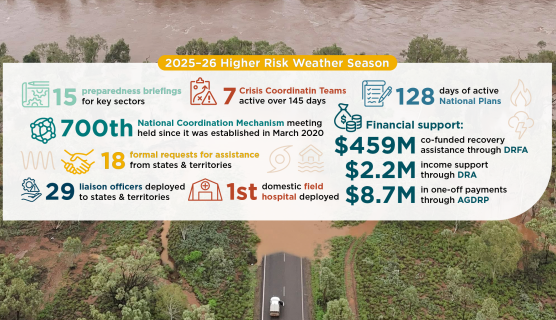
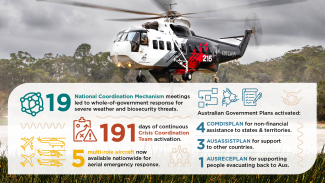
2025 saw floods, bushfires, a biosecurity threat, severe storms, and cyclones impact communities across the country. NEMA responded by standing up our Crisis Coordination Team for a total of 191 days and we held 19 National Coordination Mechanism meetings for the most severe threats and disasters.

When it comes to supporting operations across the nation, as well as overseas, part of our role is to oversee and activate Australian Government Plans when they are needed. This year, we activated:

  • Disaster Response Plan (COMDISPLAN) 4 times, to provide critical non-financial assistance to states and territories
  • Overseas Assistance Plan (AUSASSISTPLAN) 3 times, to deliver support in other countries
  • Plan for the Reception of Australian Citizens and Approved Foreign Nationals Evacuated from Overseas (AUSRECEPLAN) once, to support evacuation efforts from a disaster overseas.

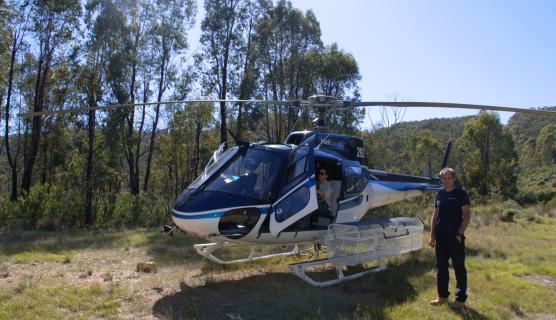
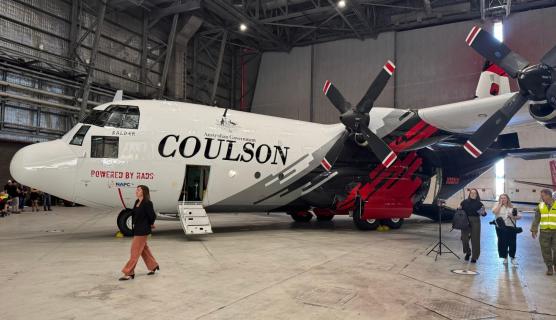
Coming into the Higher Risk Weather Season for 2025–26, we now have 5 dedicated multi-role aircraft available nationwide for aerial emergency response. Piloted on behalf of the Australian Government, these planes and helicopters can help fight fires from the air, evacuate people, deliver supplies and scope out terrain before, during and after disasters, anywhere in the country.

Photo of a helicopter hovering just above a dam, refilling for aerial firefighting. The sky is cloudy and the helicopter has Coulson and Australian Government branding on the side. Overlaid on the photo is an infographic with the statistics mentioned under the heading 'Emergency response at scale'.

Stakeholder engagement and preparedness

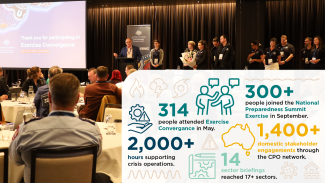
It was a big year for engagement, with over 300 people participating in each of our key annual exercises.

  • Exercise Convergence, held in May, explored an all-hazard scenario with a range of consecutive, compounding and complex events (think natural hazards, cyber threats, biosecurity threats, supply chain shortages all happening at once). The exercise was an opportunity for all levels of government and industry organisations to test and explore their plans and arrangements to identify opportunities for improvement if the worst happens.
  • The National Preparedness Summit Exercise was held in September, just ahead of the Higher Risk Weather Season. Each year the exercise is based on then-current long-range forecast and real weather events to stress-test plans and arrangements for the season. Leaders from all levels of government, industry and the not-for-profit sector came together to better understand the risks ahead and ensure communities across the country are prepared to respond swiftly and effectively.
Photo of a conference - people sitting around tables, someone presenting at a lectern on a stage with another 10 peopled lined up on the stage, one with a large bunch of flowers. The PowerPoint slide next to the presenter says 'Thank you for participating in Exercise Convergence'. Overlaid on the photo is an infographic with the statistics mentioned under the heading 'Stakeholder engagement and preparedness'.

We delivered our stakeholder preparedness briefing program 14 times to over 17 sectors. On top of these structured programs, our Coordination and Planning Officers held over 1,400 stakeholder engagements across the country and spent over 2,000 hours supporting crisis operations as Liaison Officers.

Disaster recovery and resilience funding

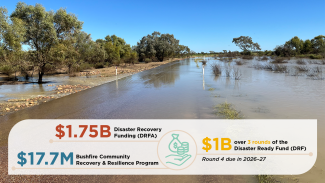
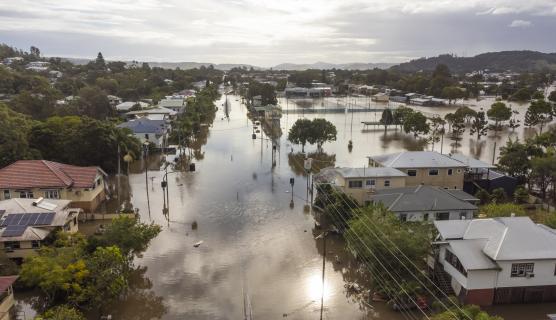
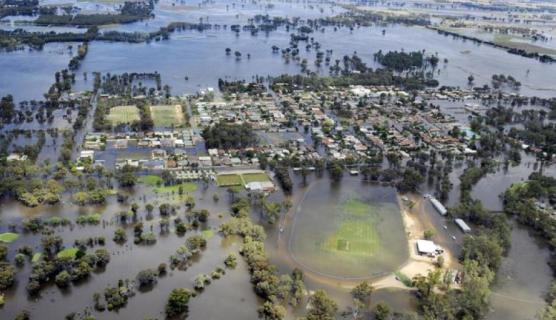
This year, NEMA delivered around $1.75 billion to states and territories through the Disaster Recovery Funding Arrangements. This helped communities impacted by disasters including the bushfires across Grampians in Victoria, Cyclone Alfred, and the southeast Queensland and Mid North Coast New South Wales floods, among many others.

We recently wrapped up Round 3 of the $1 billion Disaster Ready Fund, the Australian Government’s flagship initiative for disaster resilience and risk reduction. The funded projects across Australia address the physical and social impacts of disasters on our communities. Round 3 funded a range of projects, from Alice Springs’ new Emergency Coordination Facility to Launceston’s freshly funded Flood Mitigation Plan. Applications for Round 4 will open in the new year—watch this space!

We have also continued supporting people impacted by the 2019–20 bushfires through programs like the Bushfire Community Recovery and Resilience Program, with $17.7 million of funding for projects led by communities across Victoria and New South Wales.

Photo of a very wide, flooded road. The sky is bright blue and bush lines either side of the road (it's not in a city). Overlaid on the photo is an infographic with the statistics mentioned under the heading 'Disaster recovery and resilience funding'.

Building community resilience

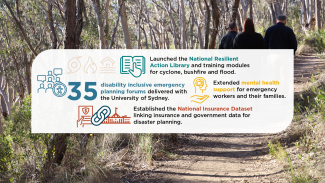
A big achievement this year for building community resilience was launching the National Resilience Action Library and training modules for cyclones, bushfires and floods. The library is full of resources and practical steps for homeowners so they can improve their resilience to natural hazards.

We also established the National Insurance Dataset that links policy-level insurance information with a range of Australian Government data for disaster planning.

In partnership with the University of Sydney, we delivered 31 in person and 4 online disability inclusive emergency planning forums with local, state and Australian government officials to support the rollout of the Disability Inclusive Emergency Management Toolkit.

NEMA also delivered the Mental Health Support for Emergency Services Workers grant program which extends mental health support to emergency services workers and their families, currently through to 31 December 2026.

Photo of bushland and a dirt track with 3 people walking away from the camera. Overlaid on the photo is an infographic with the statistics mentioned under the heading 'Building community resilience'.

Strategic recovery and international engagement

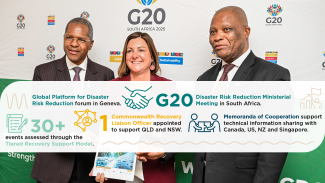
Team NEMA’s work went far beyond Australia’s borders. We supported the Minister for Emergency Management at the G20 Disaster Risk Reduction Ministers Meeting in South Africa in October and supported NEMA’s leadership at the Global Platform for Disaster Risk Reduction in Geneva in June. We used these events to showcase Australia’s approach to disaster risk reduction and recovery and hear from other countries about their experiences. We continue to leverage our Memoranda of Cooperation with countries including Canada, United States, New Zealand and Singapore, to support technical information sharing on emergency management and disaster risk reduction issues.

Through the Tiered Recovery Support Model, NEMA assessed over 30 events that impacted communities across Australia in 2025. This was to enable a strategic, integrated and coordinated Australian Government approach to support disaster recovery.

This year, we appointed a Commonwealth Recovery Liaison Officer and associated support team from February to September to manage and streamline Australian Government support for recovery effort across multiple significant events in Queensland and New South Wales.

Photo of the Minister flanked by 2 men, in front of a media wall with G20 South Africa logos. They are posing and holding a document (we can't see the title) and smiling off camera. Overlaid on the photo is an infographic with the statistics mentioned under the heading 'Strategic recovery and international engagement'.

This momentum won’t stop in 2026, with nationally significant operational capabilities like Australia’s first National Messaging System to be delivered and the next round of the Disaster Ready Fund continuing to uplift Australia’s ability to withstand disasters.

Behind every statistic is a story of teamwork, resilience and innovation. Team NEMA’s achievements in 2025 show Australia’s commitment to adapting and strengthening its emergency preparedness, response and recovery systems. With thousands of hours contributed, hundreds of stakeholders engaged and billions of dollars in support delivered, these data points reflect a nation dedicated to protecting communities from the unexpected.