Australian Warning System

On this page

Australian Warning System

What is the Australian Warning System?

The Australian Warning System (AWS) provides a consistent approach to emergency warnings across Australia. It covers bushfires, floods, cyclones, severe storms and extreme heat. It helps you understand how serious an emergency is and what you need to do.

The AWS uses 3 warning levels with consistent colours, symbols and instructions. These help you recognise warnings and make decisions about your safety, whether you are at home or travelling in another state or territory.
What do the warning levels mean?

Each warning includes a level that tells you how serious the threat is, along with instructions about what you need to do.

  • Advice (yellow): An incident has started. There is no immediate danger. Stay informed in case the situation changes.
  • Watch and Act (orange): The threat has increased and conditions are changing. Start acting now to protect yourself and your family.
  • Emergency Warning (red): This is the highest warning level. You may be in danger. Act immediately. Any delay could put your life at risk.
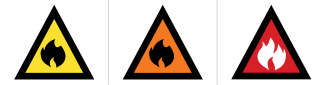
Three warning triangles with thick black outlines: first is yellow with a black fire icon, second is orange with a black fire icon, third is red with a white fire icon.

Fire warning levels

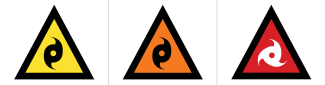
Three warning triangles with thick black outlines: first is yellow with a black cyclone symbol, second is orange with a black cyclone symbol, third is red with a white cyclone symbol.

Cyclone warning levels

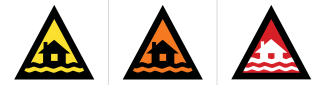
Three warning triangles with thick black outlines: first is yellow with a black house and waterlines across it, second is orange with a black house and waterlines across it, third is red with a white house and higher water lines across it.

Flood warning levels

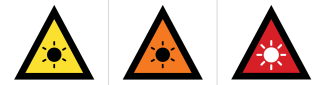
Three warning triangles with thick black outlines: first is yellow with a black icon of a sun, second is orange with a black icon of a sun, third is red with a white icon of a sun.

Heat warning levels

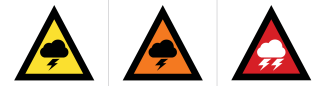
Three warning triangles with thick black outlines: first is yellow with a black icon of a cloud and lightning bolt, second is orange with a black icon of a cloud and lightning bolt, third is red with a white icon of a cloud and two lightning bolts..

Storm warning levels

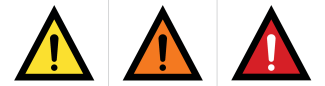
Three warning triangles with thick black outlines: first is yellow with a black exclamation mark, second is orange with a black exclamation mark, third is red with a white exclamation mark.

Other hazard warning levels

Always read the full warning and follow the instructions from emergency services. Do not ignore an Advice warning. If you receive a Watch and Act warning, take the recommended action rather than waiting for an Emergency Warning.

How does it work?

Emergency services use this consistent approach when issuing warnings for their communities. Each warning includes:

  • A warning level: Advice, Watch and Act or Emergency Warning tells you how serious the threat is.
  • A symbol and colour: The symbol shows the type of hazard. The colour shows the warning level.
  • An action statement: This tells you what to do. Examples include ‘stay informed’, ‘move to higher ground’ or ‘shelter indoors now’. The instruction depends on the hazard and local conditions.

AFAC coordinated the national work to develop the AWS. 

Emergency services share warnings through their websites, apps and social media. During an incident, check more than one trusted source and continue checking for updates.

The AWS is different from the Australian Fire Danger Rating System. Fire danger ratings tell you how dangerous a fire would be if one started. AWS warnings tell you about an incident and what you need to do.

What funding has the Australian Government provided?

NEMA provided $2 million through Round 2 of the Disaster Risk Reduction Package to support the national ‘Know the Signs’ education campaign. The campaign helped communities understand the AWS and what to do at each warning level.

Round 4 of NEMA’s Disaster Risk Reduction Package also provided $1.274 million to the Bureau of Meteorology to develop consistent weather warnings in line with the AWS.

Where can I learn more about the AWS?

Visit the Australian Warning System website or the Australian Disaster Resilience Knowledge Hub to learn more about warning levels, symbols and action statements.

For current warnings in your area, check the emergency services website for your state or territory, or an official warning app if available:

Last updated