Aerial firefighting fleet ready to respond this HRWS

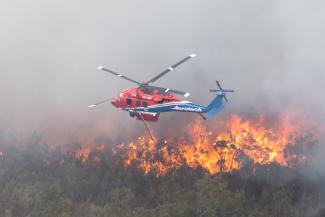
Aerial photo of a red and blue helicopter flying low over burning bushland, with lots of bright flames and thick smoke

A UH-60L Blackhawk from the National Aerial Firefighting Fleet. Photo: Aerotech Helicopters.

On this page

Aerial firefighting fleet ready to respond this HRWS

Aerial photo of a red and blue helicopter flying low over burning bushland, with lots of bright flames and thick smoke

A UH-60L Blackhawk from the National Aerial Firefighting Fleet. Photo: Aerotech Helicopters.

Written

With another Higher Risk Weather Season (HRWS) underway, aerial firefighting is a vital element of Australia’s national firefighting toolkit.  

The National Aerial Firefighting Fleet’s highly specialised aircraft include helicopters, fixed-wing air tankers and amphibious scoopers. These aircraft are equipped for battling bushfires both locally and internationally.  

Through the Australasian Fire Authorities Council’s (AFAC) National Aerial Firefighting Centre (NAFC), the Australian Government has committed an additional 3 years of funding to the fleet, helping to ensure aircraft can be rapidly deployed wherever and whenever disasters strike.

Five Australian Government-funded aircraft will form part of the national fleet in 2026-27:

  • National Large Air Tanker Lockheed C-130Q (New South Wales)
  • Birddog Cessna Citation 550 (New South Wales)
  • Bell 214ST helicopter (Queensland)
  • UH-60L Black Hawk helicopter (Victoria)
  • UH-60L Black Hawk helicopter (South Australia) 
What is aerial firefighting?

Aerial firefighting aircraft support ground crews by lowering the flame height and intensity to help control and supress the fire. The fleet is an important part of how we manage the threat of bushfires in Australia. In 2026-27 NAFC contracts about 169 aircraft on behalf of state and territory governments.  

The core functions of the aircrafts include:

  • firebombing (dropping water or foam on fires)
  • assisting ground crew to contain the spread of fire
  • gathering information from the air to help with coordination, communication and fire mapping
  • inserting, lifting and transporting firefighters, equipment and supplies.  

While the primary role is firefighting, the aircraft can also support communities in other ways, including supplying essential goods to isolated communities and critical logistics support for emergency services.

A UH-60L Blackhawk firebombing. Footage: Aerotech Helicopters.

Supporting each other to fight bushfires

Most recently, NSW supported around-the-clock firefighting operations in France with specialised night firebombing aircraft deployed with the assistance of the ADF.

AFAC’s National Resource Sharing Centre (NRSC) facilitated teams of firefighters from Australian agencies to assist in Canada and the United States.

Our international partners have also come to Australia’s aid in past seasons, deploying personnel and assets to assist us in previous firefighting efforts across the country.

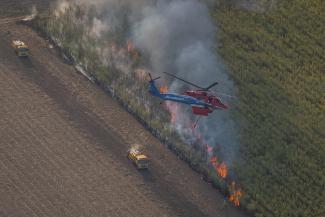
Aerial photo of a red and blue helicopter flying over a field at the front of a fire, the hose for firebombing visible out the bottom of the helicopter. Two yellow firetrucks are on the ground in front of the fire front.

A UH-60L Blackhawk working alongside ground crews. Photo: Aerotech Helicopters.

Preparing for bushfires this HRWS

Preparation matters – severe weather can happen at any time. In Australia, the period between October and April is when bushfires and other events such as heatwaves, severe thunderstorms and flooding are more likely to occur.  

You can prepare now. Make sure you, your family and your friends have emergency plans in place. Explore our Support and resources hub for practical and location-specific actions and resources to help you prepare.