
August/September 2026: We are currently updating our contact database for NCM communications. Keep an eye out for an email from us.
National Coordination Mechanism
On this page
National Coordination Mechanism
Australians are familiar with hazards like bushfires, floods and cyclones but you may not be aware there are national crisis arrangements to coordinate before, during and after crises.
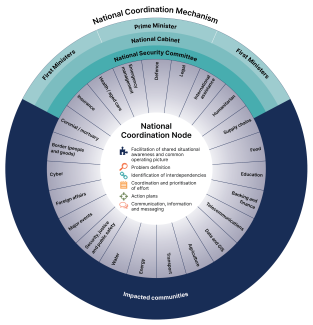
This is where the National Coordination Mechanism (NCM) comes into play. It is an Australian Government collaboration tool that brings together the right people across Australia for crisis management.
The NCM in action
NEMA is the custodian of the NCM, which is identified within the Australian Government Crisis Management Framework (AGCMF) as the peak senior officials’ crisis coordination mechanism.
The NCM is an all-hazards, flexible, scalable and adaptable Australian Government capability. When activated, it provides a national picture of a crises to help reduce harm to individuals and the community. It helps to manage the consequences of crises on Australian communities by enabling stakeholders to coordinate, communicate and collaborate before, during and after crisis events.
During crises, the NCM uses stakeholder networks to expand its reach. It shares information, defines problems and finds solutions to stabilise crises quickly. It supports decision making and promotes collaboration between stakeholders with equity in the crisis, strengthening and formalising the existing relationships between governments, industry and civil society.
Key features of the NCM:
- can consider any crisis topic
- flexible and scalable
- defines problems
- shares situational awareness
- assigns responsibility for solutions
- promotes stakeholder collaboration
- strengthens ties among governments, industry and not-for-profit organisations
- uses national capabilities.
In crisis situations, the NCM aims to:
- maintain real-time awareness
- define the problem
- mitigate crisis impacts
- stabilise crises quickly
- coordinate actions
- provide national leadership
- manage public messaging
- keep public trust
- support community functions.
Types of NCMs
| NCM-AUSGOV | NCM |
|---|---|
|
|
Who is involved?
The NCM is not a committee and has no standing membership. Attendance is by invitation only and can vary depending on the crisis. We may invite Australian, state, territory and local government officials, along with relevant industry, not-for-profit representatives and expert advisors.
In determining NCM participation, we consider those being impacted by the crisis, those who have relevant knowledge and experience and those who have a potential role in identifying and implementing stabilising actions. NCM participants are invited to share situational awareness, rapidly define problems, consider second and third order consequences and identify actions to mitigate or manage those consequences.
In most cases, we send information shared in NCMs across a participant’s network to help provide shared situational awareness.
We may hold NCMs for complex crises affecting single sectors, or for multiple sectors where we require coordination for effective consequence management. NCMs may also assist participants to prepare for potential crises through preparedness activities. This could include exercises and briefings or after-action reviews to support continuous improvement.
NCM activation
NEMA’s Deputy Coordinator-General for Emergency Management and Response (DCG EMR) (or delegate) activates the NCM on behalf of the Australian Government. Australian Government agencies may request NCM activation by contacting us.
States, territories, industry or the not-for-profit sector may request that we activate the NCM for a specific purpose or issue.
Invitation arrangements
We often use the ‘network of networks’ principle to distribute NCM invitations, by asking invitees to amplify to relevant contacts. We ask key stakeholders, including Australian Government agencies, to update invitee contact details on a regular basis. However, some NCMs may have a limited number of invitees. Also, attending an NCM will not guarantee an invitation to future NCMs.
Roles and responsibilities
Chair and co-chair
Our DCG EMR (or delegate), chairs or co-chairs the NCM. In specific circumstances, other Australian Government Coordinating Agency (AGCA) senior officials may chair the NCM.
The NEMA chair may invite other senior representatives to co-chair an NCM and provide advice to us to ensure the NCM runs smoothly.
National Emergency Management Agency
We deliver the NCM through the National Coordination Mechanism Operations team to ensure agreed actions remain synchronised, coordinated and responsive to the needs of all stakeholders.
Australian Government Coordinating Agency or requesting agency
Under the AGCMF, it is the responsibility of the AGCAs and Lead Coordinating Senior Officials (LCSOs) to ensure their agency is prepared and positioned to coordinate Australian Government actions in response to crisis or crises caused by their designated identified hazards. This includes ensuring their agency maintains current contact information for key stakeholders.
If a specific crisis arises and there is no national plan in place, the lead Australian Government agency will be the responsible AGCA. We will work with this agency to deliver the NCM. Where there is no identifiable AGCA, we will fill this role and deliver the NCM.
States and territory government agencies
State and territory government agency participation in an NCM usually begins with ministers’ departments and emergency services agencies. The state or territory representatives must have the ability to make decisions on behalf of their jurisdiction and agree to action items.
Industry and not-for-profit participants
Industry, particularly critical infrastructure industry participants, and not-for-profit participants are important in the NCM. They provide increased situational awareness and understanding of the consequences of any crisis.
We may specifically invite Trusted Information Sharing Network (TISN) chairs and secretariat officers to NCMs, or we may ask them to amplify invitations to NCMs using their existing networks.
Last updated